• Social Currency

    I just read an interesting article called “Social Currency” by Douglas Rushkoff. This guy really hits the nail on the head regarding the purpose of content to most people, both offline and online. Although the article is a bit dated (written in January 2001), the concepts he illustrates are still very relevant today.

    He explains:

    We think of a medium as the thing that delivers content. But the delivered content is a medium in itself. Content is just a medium for interaction between people. The many forms of content we collect and experience online, I’d argue, are really just forms of ammunition — something to have when the conversation goes quiet at work the next day. An excuse to start a discussion with that attractive person in the next cubicle: “Hey! Did you see that streaming video clip at streamingvideoclips.com?”

    Social currency is like a good joke. When a bunch of friends sit around and tell jokes, what are they really doing? Entertaining one another? Sure, for a start. But they are also using content — mostly unoriginal content that they’ve heard elsewhere — in order to lubricate a social occasion. And what are most of us doing when we listen to a joke? Trying to memorize it so that we can bring it somewhere else. The joke itself is social currency. “Invite Harry. He tells good jokes. He’s the life of the party.”

    I couldn’t explain it better myself. Check out the rest of the article.
  • Getting Started with Ruby on Rails

    Recently, I decided to try out Ruby on Rails and see what all of the commotion around Rails is about. I’ve managed to get it setup on my OS X machine by following several conflicting and confusing instructions. Only after I went through the pain and suffering of manual setup did I discover Locomotive, a simple tool to develop Ruby on Rails apps. It’s everything you need all in one elegant package and you should check it out if you’re at all interested in RoR on OS X.

    Following ONLamps’ excellent getting started article (and it’s followup), I have been able to make a simple demo app that retrieved content from a database using the generate scaffold command as a foundation, but for some reason when I try to edit, delete, or do anything else I get mysterious errors relating to ActiveRecord after trying to change a few things. I’ve familarized myself with Ruby by reading some of Why’s (Poignant) Guide to Ruby (which I highly recommend reading), but I’m confused when it comes to the vast Rails API. I think I’ll be ordering Agile Web Development with Rails before going any further.

    Nevertheless, I was impressed on how easy it was to create a custom template and how retrieving stuff from the database just worked in the template. I can only imagine what stuff you can do when you actually learn to use the framework properly. 😛

  • Roland VS-840: Upgrade to EX

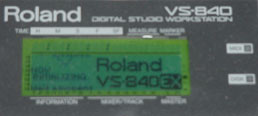
    I received my VS-840 multitrack recorder a few weeks ago and it’s a nice little machine. I am getting started with recording and this will be the heart of my setup. Despite not having anything the plug into it yet I’ve already gotten used to some of its features. However, the total time I can record on a Zip 100 disk on medium-high quality is 49 minutes between all tracks. That means for a simple stereo 2 track recording I can only record about 25 minutes at a time. That doesn’t sound too good because I plan on using this to record long concerts sometimes.
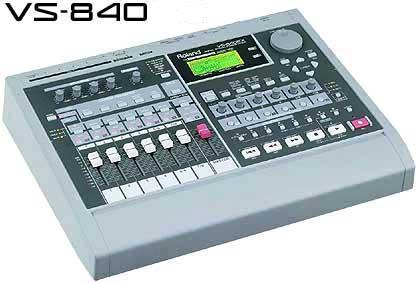
    To remedy this, I’m going to add a hard drive to the VS-840. But before I can do that, I had to upgrade the firmware to that of the VS-840’s replacement: the VS-840 EX. The difference between the two is a larger Zip 250 drive and newer firmware with more features. Although Roland offered an expensive upgrade kit for upgrading VS-840 to an EX, the secret is that the EX firmware can typicially be applied to most plain 840s. Luckily, my 840 took the firmware upgrade without an issue and I now have a VS-840 EX sans the bigger Zip drive. The smaller Zip drive is okay though, because now with the new firmware I can install a hard disk. If you’re interested in how I did it, check out my success story on the VS Planet forums.

    Now I have to save up for some good microphones and I’ll be set for recording!

  • Foray into Recording

    This weekend I bought a Roland VS-840 digital multitrack recorder from eBay. Ever since I’ve done audio work for Gimme 5 I’ve been wanting to do my own recording stuff and this is the first step. I plan on using it to do some simple live recording stuff at first and as I gain my own experience I can go on to other things. I still need to buy about $200 worth of microphones, stands, cables and a submixer before I can really make use of it. Obviously, for about $400 I am not going to have a studio-quality setup, but it should be good enough for a beginner who will be recording high school band demos at best.

    Until then, I’ve been reading up on the mods you can do with it. A hack that interests me is replacing the Zip 100 drive with a 2 GB hard drive. It’s relatively simple: you upgrade the firmware and use a desktop to laptop IDE adapter to install the hard disk. However, the firmware upgrade is somewhat hairy: it sometimes fails and can render the recorder useless. In addition, it’s a pain to remove the internal drive to transfer songs from the recorder to my computer.

    I plan on making an external enclosure for the hard disk and the Zip drive so I can switch between the two and hook it up to my Windows box easier. If I get it working I’ll post a howto sometime. In any case, I look forward to posting about my experiences with starting out in recording.

  • Hackaday!

    hackaday.comWow!

    I’m on the front page of Hackaday! My recent article on Linux on the 2G iPod mini was accepted as a Hackaday post… very nice. Thanks guys!

    Check out the Hackaday post if you haven’t already.