So then why would Terafab need a Free Electron Laser, and why wouldn’t they just use what ASML does currently, laser-tin droplet ablation? To answer this we should start at the beginning: the fundamental physics of semiconductor photolithography.
Laser-tin droplet ablation has low efficiency, requires one light source per scanner, and yield quality is limited by available photon power:
The last one is a real doozy – as an example, for Intel chips i5, i7 and i9 all come off the same silicon wafers using the same masks, the difference is in the statistical error rates induced by limited or irregular photon power during the masking process.
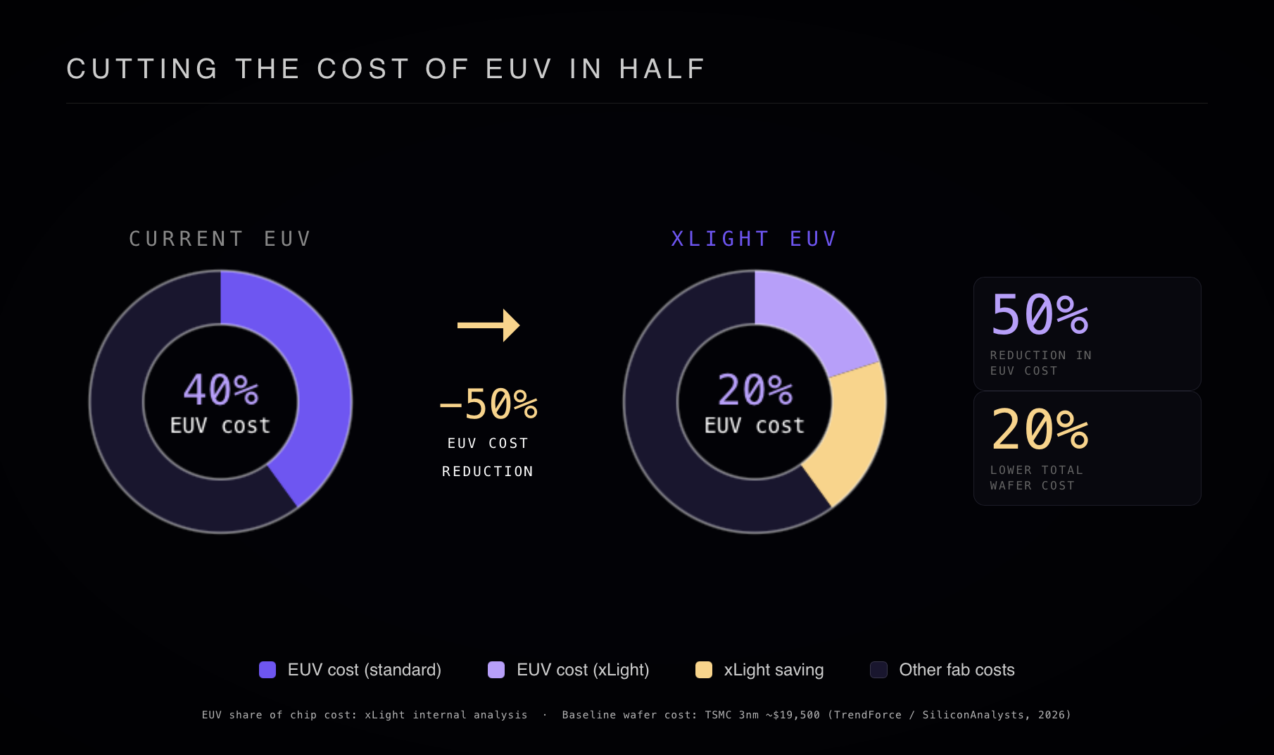
EUV light contributes ~40% of overall fab costs. Using an alternative light source can reduce the EUV cost by 50% which would contribute to a 20% reduction in overall fab costs. And yields would be much better.
Leave a Reply