
Staff web platform engineer. One app, several products at Apple Business. I work with people supporting American manufacturing and business growth.
-
Redesigning source control ↗︎
Anthropic:
At Anthropic, coding is no longer the bottleneck to building systems or doing research. Claude is able to autonomously iterate on research loops, micro-optimize complex programs, and build new services from the ground up at a speed and scale we haven’t seen before. The bottleneck, now, is all of the developer infrastructure built for human scale: source control, builds, and CI.
In May 2026, Anthropic averaged around 2,500 code changes merged per day; as of September, we merged over 30,000 per day.
In order to support this growth, we built Scion, an in-house version control system, and fully migrated our monorepo from git in five months.
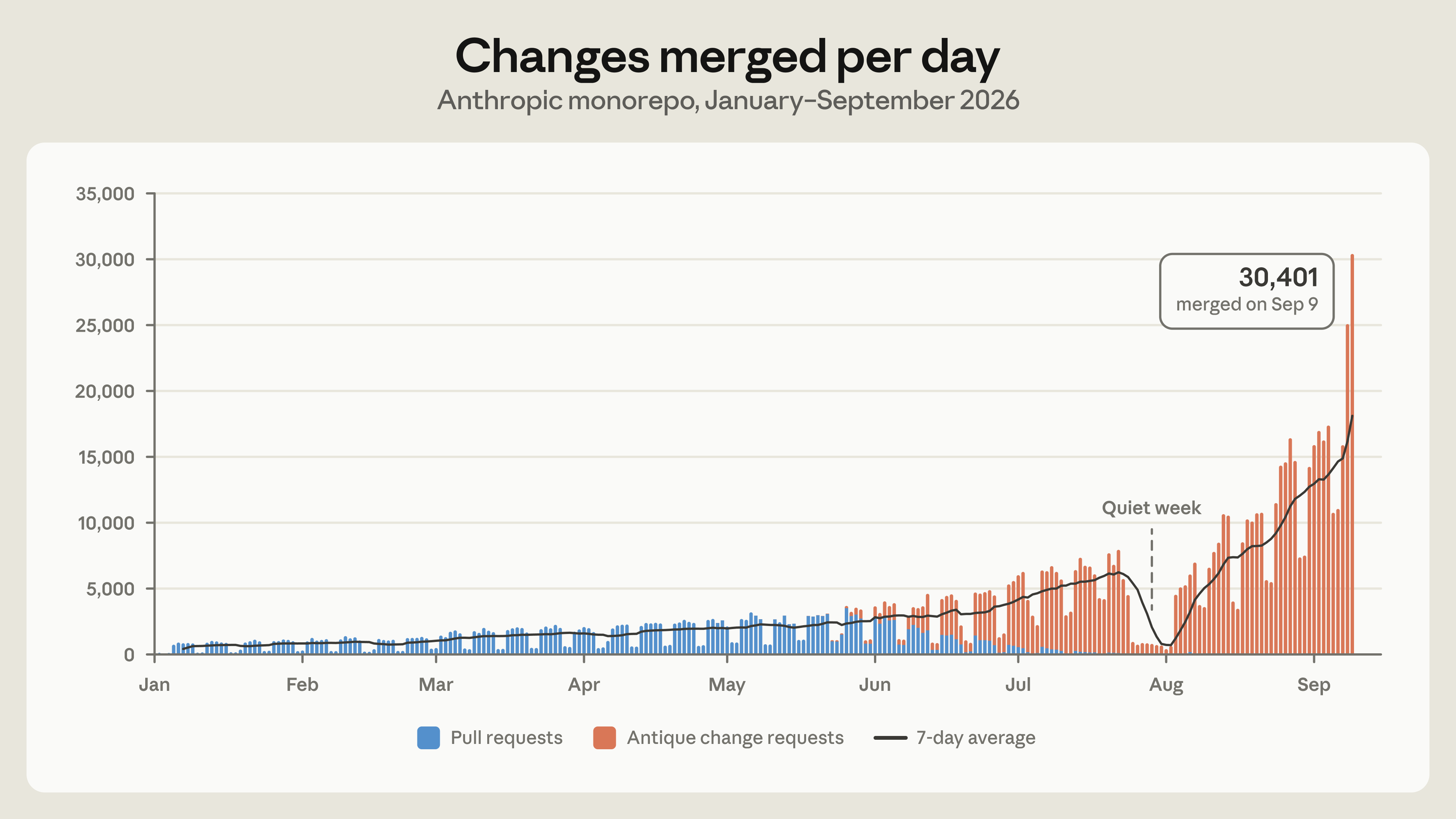
Changes merged per day in Anthropic’s monorepo. Chart: Anthropic. Scion isn’t the only way to scale for agents. Cursor’s Git at any scale describes Continuity, a git store that keeps a write-ahead log in S3 as the source of truth and treats every repo on disk as a disposable cache. It came along as Tobi Lütke was frustrated with Shopify’s internal git system, so he implemented it over a weekend as walgit: an open-source Rust git server that runs as one binary in front of an S3 or GCS bucket, with no database and no leader, serving fetch, push, LFS and fast bundle-based clones even for repos larger than the machine serving them.
Ryan Dahl noted what makes this pattern practical now: S3 has supported compare-and-swap since 2024, so walgit can use the bucket for both storage and coordination.
Two months later, all of Shopify runs on an internal version that has diverged so far Tobi can’t maintain the public one:
-
Native is now the future of mobile at Shopify ↗︎
It’s tempting to just point an LLM to the React Native codebase and try to one-shot the same features in native, but it doesn’t work. Even if you ask it to gather as much information as it can up front, freeze that into specs, task files, and then implement it, you end up with a huge amount of unmaintainable code that can’t be shipped.
To solve this problem, we built a system called Helix that takes a more gradual approach. It doesn’t expect the first output to be correct, and builds a loop where an imperfect attempt simply cannot move forward until it becomes a good result.
The developer points Helix at a screen. Helix reads the React Native code and proposes a sequence of checkpoints (small, ordered slices of the work) that can be reviewed in minutes. Then, checkpoint by checkpoint, it builds: each one must prove its behavior with tests, match the running app in a visual review, survive two adversarial code reviewers, and get a human’s nod before it’s committed and the next one starts. Feedback from every review is remembered, so the loop gets more autonomous as the migration progresses.
-
Home Hardware, Part 1: My Control4 Revenge Arc ↗︎
Jessie Frazelle is making her own Home Assistant compatible hardware:
People have been tweeting ridiculous PCB images for the last few days, since Astra came out. I already knew the models were good at datasheet review before Astra. The win isn’t one-shotting a PCB. It’s getting through the work an electrical engineer would do, including the parts you hate doing.
Astra will have competition:
-
pi-fabric ↗︎
Fabric gives Pi one programmable tool called
fabric_exec, which composes core tools and MCP servers with captured extension tools in a checked TypeScript program. That program can call agents or actors, use durable coordination, and run inside QuickJS. Trusted workloads that exceed WASM32 memory may use the unsafe Node process. After execution, the conversation receives the result of the program’s branches, loops, fan-out, and data flow.🏆 100% on ARC-AGI-3. A Fabric-powered agent won all 25 environments in one 22.4-hour session with 4 minutes of human time ($1,349 in model spend).
-
Styling Linear for the future with StyleX ↗︎
The client went from injecting hundreds of CSS rules during a navigation to zero. Arguably the more valuable change, though, is that styling now has much clearer boundaries at Linear. Components have explicit styling contracts, precedence is deterministic, and many patterns that used to depend on convention or the cascade are now enforced by tooling.
I wrote about StyleX last year and maintained a very similar atomic CSS system at Yahoo. Linear just finished a 1,000-PR migration onto it, in part to help agents write UI at scale.
Beware the pitfall of choosing large API surfaces:
styled-components made this a particularly difficult migration to automate because it gives you a Turing-complete language, the full power of CSS, and a completely open API. There are countless ways to express the same intent, and at the time, it was uncomfortably easy for agents to output something that looked correct but wasn’t.
What I like about StyleX is its minimal API surface. Contrast to Panda CSS which provides a large API surface and countless ways to express the same intent. Simplicity wins.
Follow
Currently Reading
- Good News Plan, very similar to the M’Cheyne Plan by Scottish preacher Robert Murray M’Cheyne (1813-1843)
- The Strenuous Life by Theodore Roosevelt
Using CrossPoint Reader on an Xteink X3.
Featured Blog Post
-
Starting at Apple
I will help small businesses succeed by building Apple Business Essentials — a product which brings together device management, 24/7 Apple support, and iCloud storage into flexible subscription plans. More →